

High lift is not a marketing label. It is a set of dimensions that let a skid steer clear tall truck sides, feed hoppers cleanly, and stack lighter materials higher with fewer ramps and less risk. This guide explains the geometry that matters, the operating habits that keep cycles fast, and a practical way to compare machines fairly. It is written for crews who run routes, recycle yards that live at full height, farm operators who load mixers and bins, and contractors who want a machine that makes tall work routine.
What high lift means on a job site
High lift describes a skid steer that reaches further and higher at the top of the stroke so you can clear tall obstructions without building ramps or spilling. It is not only about hinge pin height. You need usable dump clearance with a real bucket at a real dump angle, forward reach that gets the cutting edge past the inner wall of a truck bed or hopper, and enough rollback at height to carry a heaped load without dribbling down the back of the bucket.
When you add those pieces together the machine spends more of the day working and less time shuffling. Drivers stop climbing in and out of trucks to check rails. Your loader keeps a smooth rhythm because it does not need to pause at the top while the operator fights geometry. Small numbers on paper add up to minutes per truck, and minutes add up to real money by the end of a shift.
Core geometry you can measure in ten minutes
Skip vague claims. Measure the four dimensions that decide everything at full height. You do not need a lab. A tape, a marker on the wall, and your bucket are enough.
| Dimension | What it controls | How to measure fast |
|---|---|---|
| Hinge pin height | The arc height that the loader arms can achieve | Ground to pin center at full lift with your common tires or tracks |
| Dump clearance at height | Bottom of bucket to ground when fully dumped at full lift | Lift to full height, roll to your true dump angle, measure to ground |
| Dump reach at height | Horizontal distance from the front tire or track to the cutting edge at full dump | Set a chalk line at the truck inner wall and measure to the edge |
| Rollback at height | How much the bucket can roll back at full lift without spill | Lift a heaped load, roll back slowly, check for dribble over the back |
These four values tell you whether the machine will clear rails, avoid splash back, and place material cleanly. Measure them with the bucket you will run every day. A narrow demo bucket can make a weak machine look strong.
Where high lift pays for itself
High lift models shine anywhere tall sides or lips steal time. If you touch any of these tasks weekly, you will see payback quickly.
- Loading high sided dump trucks without ramps or boards.
- Feeding side dump and front feed hoppers where the lip sits well above tire height.
- Stacking light material buckets at yards where piles reach over the cab.
- Placing pallets on second tier racks from the ground with forks and a tall backrest.
- Grain and feed work where you must reach into mixers and tall wagons without spill.
- Recycling yards with thick bin walls that demand honest reach at full dump.
The common theme is less time at the top of the stroke and fewer half dumps. Every hesitation at height echoes through the day. When geometry works, the machine stays calm and cycles repeatable. Crews finish earlier and equipment lives longer because it is not bouncing at the limit of travel on every pass.
Vertical lift and radial lift in real work
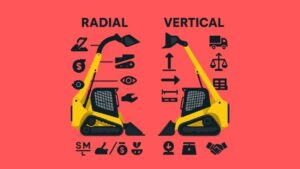
A vertical lift linkage keeps the bucket level as you raise it and pushes forward near the top of the stroke. That forward push is what gives you dump reach and lets the cutting edge clear the inner wall of a truck or a hopper lip. A radial lift machine follows an arc. It often feels smoother at mid height and can be lighter, but it will not match a vertical lift machine at the top where high lift matters most.
- Pick vertical lift if trucks, bins, or tall hoppers are part of your week. The forward motion near full height is the advantage you need.
- Pick radial if your work is mostly digging, back dragging, and loading low sided trucks. It may save money upfront and feel precise on the ground.
There are exceptions and strong radial machines that surprise people. You still make the call by measuring the four dimensions at height with your bucket. If a radial unit hits your marks, run it. If not, do not try to fix geometry with operator skill alone.
Buckets and forks that protect height and reach
Attachments can steal the clearance you just paid for. Choose profiles and guards that carry your height to the job rather than taking it away.
General purpose and light material buckets
General purpose buckets are fine for dense materials and grading, but their floor length and back height can cut into dump clearance at full lift. Light material buckets often have taller backs that keep material in the pocket during travel. The tradeoff is added height and floor length that reduce clearance at the top if you do not size them with the machine in mind. The right answer is to demo with both profiles and mark whether the cutting edge clears the inner wall of your tallest truck bed by a comfortable margin.
Side dump hoppers and grain work
Side dump buckets need clean forward reach at height. Weak reach forces the operator to shake the bucket to get material over the lip, which shortens bearing and pin life. In grain and feed, rollback at height matters as much as reach. You want the material to stay seated at full lift while you approach. Then you want a predictable dump angle that flows into the mixer rather than splashing back on the cab door.
Pallet forks and backrests
Fork work benefits from high lift because second tier racks and tall flatbeds are common. Use a carriage with a tall backrest so product stays planted at height. Side shift is useful, but do not let side shift frames take so much vertical real estate that you cannot clear the headboard or stakes. Keep the forks short when you can because long forks can hit bed rails before the carriage clears the wall at full lift.

Numbers that matter more than brochure headlines
Manufacturers publish hinge pin height and rated operating capacity. You still need to translate those into practical targets so you know if the machine will do your specific work without hacks. Use these thumb rules to frame demos and quotes.
| Use case | Target hinge pin height | Target dump reach at height | Notes |
|---|---|---|---|
| Single axle landscaper dumps | 120 to 130 inches | 24 to 30 inches | Often fine for mid frame vertical lift with GP bucket |
| Tandem dumps at factory rail height | 130 to 140 inches | 30 to 36 inches | Large frame vertical lift makes this routine |
| Tall side inserts and recycling bins | 140 to 150 inches | 34 to 44 inches | Factory high lift arms or high lift package recommended |
| Feed mixers and high wagons | 130 plus inches | 30 plus inches | Rollback at height is as important as reach |
Use comfortable margins. A machine that barely clears a truck on the yard will fight you on a broken lot with snow or mud. Two inches of paper advantage can vanish in real conditions. Test where you work and include the tires or tracks you plan to run, not the ones on a showroom demo.
Stability with tall loads and how to keep it
High lift raises the center of mass and moves it forward. That changes feel as you approach full height. You keep stability by managing weight balance, stance, travel speed, and approach technique. You also keep it by choosing tires or tracks that fit your surfaces and by adding counterweights when they help more than they hurt.
Tires, tracks, and counterweights
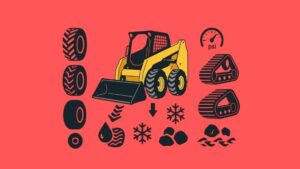
- Tires are lighter and move quickly between piles. They pitch more on broken pavement at the top of the stroke. Counterweights on a tire machine can calm the last foot of motion and add confidence with loose material buckets.
- Tracks widen the stance and reduce bounce near full lift. They add transport weight and cost per hour. In rough yards and on soft ground tracks usually make the day easier.
- Counterweights are not a universal fix. They do not add dump reach or rollback at height. They only shift balance and change the feel. Use them when tall light materials and high bins are routine. Skip them when transport limits and ramps dominate your week.

Rated operating capacity and load center
Rated operating capacity is measured at a set load center that may not match your bucket or forks. Long floor buckets and long pallets move the mass out, which eats into your margin at height. If your work uses longer than typical load centers, adjust your internal limits accordingly. Training operators to carry low and slow on approach, ease to neutral to stop, and finish the dump in one smooth motion does more for stability than any single spec on a sheet.
Surface and approach planning
High lift feels best on flat, firm ground. You do not always get that. Clean turning areas, fill potholes you will cross all day, and approach at a shallow angle rather than aiming straight at a lip that can bounce the machine. Keep carry height low with rollback until you are ten feet from the dump. Raise as you brake, stop smooth, then complete your dump. It is slower on paper and faster in the real world because you do not have to fix spills or back up from a hard bounce.
Hydraulics and motion at full height
At the top of the stroke you are near end of travel in lift and tilt. Some machines slow down or feel sticky because they are on relief. Others include regeneration circuits that speed tilt in specific directions. None of that is a problem if you know how your machine behaves and you match it with your attachments and material.
Relief behavior and flow
- Lift slows as you hit stops. If your machine spends every cycle on relief at the top, you waste heat and time. Speak with your dealer about set points and verify you are seeing spec values at the couplers.
- Tilt regeneration can make roll out fast and roll back slower at height. Train operators to expect the change so they do not over correct near rails.
- Cooling matters. Loading light material at tall bins often means long periods at mid throttle and frequent tilt motion. Keep coolers clean and fans healthy. Hot oil makes controls sluggish and operators chase motion with their hands.

Visibility and lighting when the bucket is high
At full height the corners of the bucket and fork tips are the only landmarks that matter. Add visual aids that reduce guesswork. You will see fewer rail marks and faster cycles on day one.
- Keep glass clean and wipers in good shape. Dirt at eye level is a time tax.
- Add a hood marker or small corner flags on bucket edges to cue distance at height.
- Run a rear camera and forward work lights aimed to avoid glare at the lip you target.
- Use a tall backrest on forks so product sits against a plane the operator can see.
- Teach spotter signals and use radios on loud sites. Communication beats guessing.
A fair demo protocol that exposes the truth
Fair demos are simple. Control variables so only geometry and machine behavior change.
- Use your bucket and forks on both machines. Do not accept a narrow demo bucket that makes reach look better than it will be on your route.
- Measure hinge pin height, dump clearance at height, dump reach at height, and rollback at height with chalk marks and a tape. Write the numbers on a board.
- Time six cycles from the same pile to the same truck or mock wall. Average the times. Note any pauses at the top or spills. The smoothest machine usually wins real work even if it is not the tallest on paper.
- Repeat with the light material bucket you would run on a windy day. Some linkages get nervous at the top with wide buckets. Better to find out now.
Model families and typical ranges
Brands name packages differently, but real ranges are similar across the market. Use these bands as a starting point before you pull a machine for a demo.
| Family | Typical hinge pin height | Dump reach at height | Common use |
|---|---|---|---|
| Mid frame vertical lift | 120 to 130 inches | 24 to 30 inches | Landscaper dumps, low hoppers, general yard work |
| Large frame vertical lift | 130 to 140 inches | 30 to 36 inches | Tandem dumps, tall bins, light material stacking |
| High lift arms or high lift package | 140 to 150 inches | 34 to 44 inches | Recycling yards, side dump hoppers, grain and feed |
If you live near the top of a band in real work, buy the next band. Margins shrink quickly on broken ground and windy days.
High Lift Models



Operator habits that speed up tall work
Technique separates crews that look fast from crews that are fast. High lift amplifies both good and bad habits. Teach these simple rules and watch cycles tighten without pushing harder.
- Carry low and rolled back until the last ten feet of approach. Your center of mass stays inside the footprint and the ride is calm.
- Ease to neutral to stop and finish the raise and dump without rocking. Jerky stops spill more than slow raises ever will.
- Look through the dump. Pick a target inside the box, not the rail itself. Aiming short makes operators pull up shy and double dump.
- Back out in a straight line and lower as you roll back. Turning with the bucket high makes small mistakes large.
- Keep glass and cameras clean. Visibility is free performance. Dirty glass taxes every cycle silently.
Inspections that keep geometry honest
Geometry drifts when pins, bushings, and stops wear. Keep the top of the stroke tight by inspecting and greasing like your hinge pin height depends on it. It does.
Pins, bushings, and linkages
- Check tilt and lift linkage pins for play each week. Side play at the bucket turns into vague motion at height.
- Grease intervals are not a suggestion. The taller you work, the more you lean on those interfaces. Dry pins cut your margin and add bounce.
- Inspect mechanical stops and cushions. If the bucket hits hard at the top, adjustments or parts may be due.
Buckets, forks, and quick attach
- Check quick attach latches for full engagement. Partial latch looks fine at ground level and lets go when you least want it.
- Replace bent fork tines and cracked bucket edges. Twisted hardware makes operators chase alignment at height.
- Verify flat face couplers seal clean. Air and dirt in oil show up first at the top where motion is slow and loads are tall.
Transport and yard layout for tall work
High lift machines are usually large frame. That means heavier trailers and a little more thought on where you park and how you stage. These small choices remove friction from a day that lives at full height.
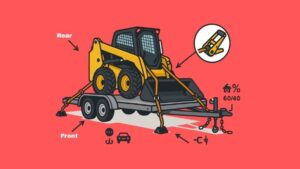
- Scale the trailer with the machine, the light material bucket, forks, and the chains you actually use. Record tongue weight and paint deck marks where the loader should park.
- Stage material piles so your approach lines are straight and your dump locations do not force tight turns with the bucket high.
- Keep a mock truck rail and a hopper lip in the yard with taped heights. New operators learn faster when they can practice at home.
FAQ
How high can a mini skid steer lift?
Most mini (stand-on/compact) units reach a hinge pin height of about 72–88 in (6.0–7.3 ft / 1.8–2.2 m). Usable dump height is typically 8–16 in (20–40 cm) lower, depending on bucket size and dump angle.
How high can a full-size skid steer lift?
Many radial-lift models reach about 114–122 in (9.5–10.2 ft / 2.9–3.1 m). Vertical-lift models often reach 126–132+ in (10.5–11.0 ft / 3.2–3.35 m). As with minis, dump height is usually 20–40 cm lower than hinge pin height.
What’s the difference between hinge pin height and dump height?
Hinge pin height is the spec most brands publish, it’s the pivot point at full raise. Dump height is the practical emptying height into a bed/container and is usually a bit lower.
Any tips for choosing the right machine for my height needs?
Measure the top edge of the truck bed/container you’ll load into, then pick a machine whose hinge pin height is at least 8–12 in (20–30 cm) higher to allow for bucket tilt and safe clearance.
Is hinge pin height alone enough to pick a high lift skid steer?
No. You also need honest dump reach at height, dump clearance at your real dump angle, and rollback at height so you do not spill on approach. Measure all four with your bucket.
Do I need vertical lift for every high sided truck?
Not always. Some radial machines meet the numbers, but vertical lift is the safer bet because it pushes forward near full height. If trucks and bins are routine pick vertical first.
How much margin should I target above my tallest rail?
Two to four inches of clearance looks fine on paper and feels tight in the field. Aim for an extra four to six inches so bumps, snow, and uneven ground do not rob your clearance.
Will counterweights fix a machine that feels nervous at full height?
They help balance, but they do not add reach or rollback at height. If geometry is the limiter you need different arms or a different family, not only more weight on the tail.
Which bucket profile works best for high lift loading?
For tall rails and hoppers many crews prefer a light material bucket with a tall back and a floor that matches the machine. It keeps material seated at height and reduces splash back.
Can I evaluate two machines in one afternoon without guesswork?
Yes. Use your bucket on both. Mark the rail height on a wall. Time six cycles. Measure reach and clearance at height. The smoother machine that clears by a margin will win on real jobs.
Does a track machine always feel safer at full lift than a tire machine?
Tracks widen stance and usually feel calmer at the top, especially on broken ground. Tires move faster and help on frequent jumps. Choose for your surfaces and travel patterns.
Why does my loader slow or feel sticky at the top of the stroke?
You may be on relief or the machine may use regeneration that changes tilt speed near end of travel. Clean coolers, verify settings, and train operators to expect the behavior.
Should I build ramps for tall trucks or buy more height?
Ramps work but they are slow, they break, and they add risk. If tall trucks are a weekly reality the right high lift machine will save time and reduce damage for years.
What is the fastest way to train new operators for tall work?
Use a simple lane with a mock rail and a pile. Carry low, raise while braking, dump once, back straight, lower as you roll back. Ten minutes a day for a week beats one big class.